John Richard Nuttall was born to Richard, a cotton weaver, and Mary Nuttall on New Year’s Day, 1st January 1880. At that time they lived at 81, Culvert, Higher Booths (Lumb?) in the district of Rawtenstall, Lancashire. Richard and Mary already had five other children living at home with them, John’s brothers and sisters: Sarah, aged 23 and a drawing frame tester, James Adam, aged 11 and working as a cotton doffer, Frederick Edward, aged 10, a giver in, Susie Annie, aged 6 and at school, and Mary Ellen, aged 3.
By 1901 John had moved to 1225, Burnley Road. He was now 21, and still lived at home with his father, who had retired, and by now was a widower. Also living with them were John’s sisters Susie Annie, 27, who worked as a cotton slubber, Mary Ellen, 24, a cotton bobbin winder. John himself was a cotton weaver as his father had been, and this all shows the involvement of the Nuttalls in the cotton industry. A cotton slubber prepared the cotton for spinning, removing the “slubs”’ or imperfections the yarn, while bobbin winder took the thread from hanks from spinning and wound them onto the bobbins.
The following year, 1902, in July, his father Richard died, aged 76.
During the next ten years, John gave up his job as a cotton weaver and became a master draper, no doubt using his knowledge and experience of cotton weaving and the cloth trade to help make the change. He married Eva Smith from Rawtenstall, in 1910, and had a son, James, born on 7th February 1911. At that time they were living at 108 Abel Street, Burnley, although his son James was born at nearby 29 Melville Street, Burnley, the home of Susie Annie and Mary Ellen.
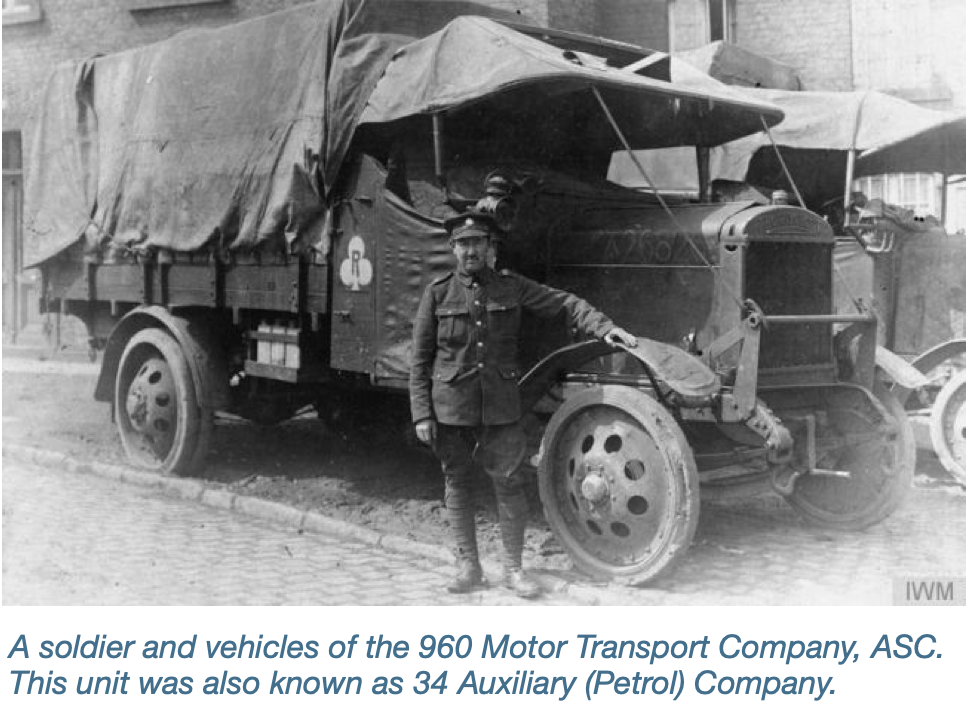
During the First World War, John served in the Army Service Corps. In 1918, the ASC became the Royal Army Corps, or RASC, in recognition of its major undertakings in supplying troops during the First World War. The Army Service Corps was the unit responsible for keeping the British Army supplied with supplies and provisions. He served with from 1914 until 1920 as Private M2/265070 with the Mechanical Transport section. He was awarded a Victory medal and the British War medal
The British and Imperial forces on the Western Front required a vast amount of ammunition, food and equipment. By November 1918 they needed a monthly issue of 67 million pounds (lbs) of meat, 90 million pounds of bread, 32 million pounds of forage and 13 million pounds of petrol. The Army Service Corps, assisted by thousands of Chinese, African and Arab labourers, was responsible for moving this material from the Channel ports where it was collected in base depots. From there it was moved by train to a regulating station from where it was entrained to either a railhead or advanced supply depot. At this point supplies would be moved by horse or motor transport to the quartermaster staff of front line units. John was a driver of motor vehicles.
By the time f the 1921 census, John had left the army and was living at 39, Spencer Street, Burnley, with his wife, Eva, and Son, James. He was employed as a “petrol motor driver at R Parkinson and Sons, Wholesale Chemists in Curzon Street, Burnley. No doubt it was his experience as a motor vehicle driver during the First World War that qualified him for and helped him get this position.
PARKINSONS’ pills, manufactured in Burnley, were once known throughout the land – and even overseas. The company claimed that it sold more pills than any other business in the world, with millions being produced annually. It was also the first anywhere to coat tablets with sugar to make them more palatable. Parkinsons’ range of products included ‘female pills’, ‘blood and stomach’ pills, soda mint tablets, and Red Indian ointment. The firm was founded by Richard Parkinson in 1848 as a chemist and dry salter, in Brierfield, before it moved to Nelson, and then into Curzon Street, Burnley.
The wholesale druggists took over Bankfield Mill, and new laboratories opened up across the road in 1924. Extensive garages for its fleet of lorries were in Holmsley Street, about half an hour’s walk from Curzon Street.
Sometime after, John moved with Eva and James, to Carshalton in Surrey, where he bought or rented an existing hardware business, Brown’s Stores in Pound Street. He is recorded in the 1937 Electoral Register for the Borough of Sutton as living with his wife, Eva, and son, James, at 65 Pound Street Carshalton. The 1939 Register shows him and Eva at the same address’s although James married in that year and moved out. At first he was helped in the store by his son, James, until James was called up and joined the army at the beginning of the Second World War.
When he retired, John returned to his roots, and bought a small semi-detached house in Water, Rossendale. His sister Mary Ellen lived in a large detached house next door. John and Mary were the last remaining children of Richard and Mary; His brother James Adam died on April 1st 1915; his brother Frederick Edward died on March 30th 1946; and his sister Susie Annie died in 1947. John lived in Water for most of the rest of his life, until his wife Eva died in 1966 and, infirm with pernicious anaemia, he moved into a care home in Haslingden, where he died in June 1975, aged 95.
Like most of the Nuttall line going back as far as at least the mid 1700s, John was a Baptist. While not being one of the Deign Layrocks, or Larks of Dean (q.v.) he did have two items of memorabilia from that time. One was a violin, which may well have been made by James Nuttall (t’violinmaker), and the second a Bible printed in 1639 that was probably owned by the Reverend John Nuttall and used as a working Bible in his travels. The violin, sadly, is now lost, but the Bible was passed to his son, and finally to his grandson Christopher, in whose keeping it remains.
Of John’s other siblings,
- Sarah, born October 1857, continued to live in Higher Booths until her death in December 1906 at the age of 49 and was buried at St Mary the Virgin, Bury. In the census, when Sarah was 14 years old, her occupation was Cotton Rover. This involved taking the mat of aligned cotton threads from the carding machine and splitting it into groups of fibres. By the 1881 census she had taken on the role of Drawing Frame Tester. The drawing process (drawing frame) plays a very big role to improve the quality of yarn in many respects such as evenness, strength, elongation at break and degree of hairiness.
- James Adam, born July 1868. By the time he was 12, he was working as a Cotton Doffer. In 1891 he married Jane Anne Aldersley of Water. They were both 23. They moved to Terracotta Buildings in Lumb and had one son, William, born around 1896. James Adam died on 1 April 1915 aged 46 at Manchester Royal Infirmary. He left £140. 1s. 10p. to Jane, his widow and only beneficiary, who survived him by 21 years.
- Frederick Edward was born on 26 February 1871, and married Rose Larter, who was born in Bacup, but had moved with her family to 124, Cleaver Street, Burnley, in 1897. Like his father, he was a cotton weaver. By 1930 Frederick and Rose had moved to St Annes on Sea and had become a postman. Rose died on 7 October 1930, and after this Frederick returned to live with his younger sister Susie at Plantation House, 7, The Crescent. Water. He died on 30 March 1946. In his will, he left £3,308 3s 1d to his younger brother John Richard.
- Susie Annie was born on 16 February 1874. On the 1891 Census Susie, then aged 17, was recorded as being employed as a Cotton Rover, like her elder sister Sarah. By 1901 she had become a Cotton Slubber, preparing the yarn for spinning and removing imperfections – or “slubs”.By the time she was 37, she was living with her younger sister at 29 Melville Street, Burnley, described in the 1911 census as having 4 rooms, not including bathrooms or toilets. By the outbreak of the Second World War, however, she was still unmarried and living with her brother Frederick at Plantation House, 7, The Crescent, Water, where she took on the role of housekeeper. Susie Annie died on 26, May 1947, just over a year after her brother. She named her sister Mary Ellen as executor of her will, leaving effects totalling £1421 6s 7d.
- Mary Ellen, born in 1877, a Cotton. Slubber by the time she was 14, was a Cotton Bobbin Winder at 24. She was still living at home at 1225, Burnley Road, Loveclough. With her parents, Frederick Edward, Susy Annie, and John Richard. By the time of the 1911 census, she had moved, with her sister Susy Annie, to their own home at 29 Melville Street, Burnley, but sometime before 1939, when she was 62, Mary Ellen had become cook to Lois Marsden, then aged 79. Lois was the mother of Carl Marsden, the family solicitor, who later read Mary Ellen’s will after her funeral As a cook, Mary Ellen lived in, at Stephen Howe, on a hillside near Ulverston in the Lake District. She died in 1969, having moved back to Water, in Lancashire, where she lived alone in a large house, but next door to her surviving brother John Richard and his wife Eva. Mary Ellen died in 1969 and was buried in the churchyard of Burnley Parish Church, St Mary the Virgin.
 Nuttall Family History