Like the everyonein the human race, the early ancestors of the family that eventually became known as Nuttall evolved as modern humans, or Homo Sapiens, in East Africa, probably between 300,000 and 200,000 years ago. They were the latest in a long line beginning with primitive primates that evolved around 55 million years ago.
Human lineages diverged from other primates between 7 and 6 million years ago. Some time after this, around 5.8 million years ago, the human ancestor Orrorin tugensis was the first to walk on two legs.
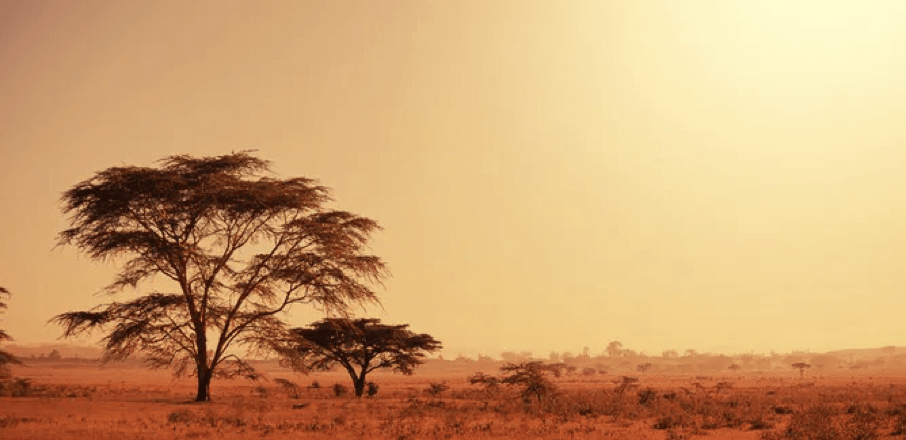
At this time the early ancestors of modern humans lived in forests, and it was not until around 4 million years ago that the Austalopithecines began to move out of the forests to live in the savannah, areas of open grassland where the trees are spaced far enough apart not to form a canopy.
Around 2.5 million years ago, Homo Habilis appeared. There is evidence that they started using basic stone tools and some had a meat-rich diet through scavenging. The first true hunter-gatherer ancestors of modern humans, however, were Homo Erectus, some 1.8 to 1.5 million years ago. They were also the first to migrate out of Africa, due to climate change, and remains of Homo Erectus have been found in Asia.
By 1.6 million years ago, discoloured sediments found in Kenya suggest that our ancestors were sporadically using fire (although more convincing evidence has been found in Israel, dating back to 780,00 years ago). There is also evidence of using more complex stone tools. This is known as Acheulean technology, and it remained the dominant technology until about 100,000 years ago.
As time passed, our ancestors started building and living in wooden shelters, such as those found near Chichibu in Japan, and by 400,000 years ago had learned to hunt with spears. Over the next 50,000 years they developed more complex blades and grinding stones.
Modern humans, Homo Sapiens began to appear on the scene at around 200,000 years ago. The earliest remains are two skulls found in Ethiopia from around 195,000 years ago.
It is from this time that current research into DNA enables us to look more closely at the ancestral lines of individual people living today. DNA is present in every living organism, including humans. The two types of DNA we are interested in here are mitochondrial DNA (mtDNA) and Y-chromosome DNA (Y-DNA).
Mitochondrial DNA (mtDNA or mDNA) is the DNA located in mitochondria, cellular organelles within eukaryotic cells that convert chemical energy from food into a form that cells can use, such as adenosine triphosphate (ATP). It was the first part of the human genome to be sequenced and now represents a mainstay of phylogenetics and evolutionary biology. It also permits an examination of the relatedness of populations, and so has become important in anthropology and biogeography.
Mitochondria are normally inherited exclusively from the mother, and this enables genealogical researchers to trace maternal lineage far back in time. The concept of a Mitochondrial Eve is based on attempting to discover the origin of humanity by tracking DNA lineages back in time. Lineage is based on haplogroups: DNA groupings shared by a distinct population made up of those people who share the same DNA variant or mutation,
Along any particular line of descent, mitochondrial DNA accumulates mutations at the rate of approximately one every 3,500 years. A certain number of these new variants will survive into modern times and be identifiable as distinct lineages. At the same time some branches, including even very old ones, come to an end when the last family in a distinct branch has no daughters.
Mitochondrial Eve is the most recent common matrilineal ancestor for all modern living humans. The number of mutations that can be found distinguishing modern people is determined by two criteria: firstly and most obviously, the time back to her, but secondly and less obviously by the varying rates at which new branches have come into existence and old branches have become extinct. By looking at the number of mutations which have been accumulated in different branches of this family tree, and looking at which geographical regions have the widest range of least related branches, the region where Eve lived can be proposed.
It important to note that the name Mitrochondrial Eve is only a familiar name: it does not mean she was the Eve of the Bible – or that she was actually called Eve. Nor does it mean that she was the only woman alive at the time – only that she was the last woman to have the base haplogroup from which all current DNA variants currently shared by humans throughout the world are descended.
Mitrochondrial Eve is thought to have lived some 200,000 years ago, somewhere in what is now the Kalahari Desert in Africa.
The male equivalent is the Y-chromosomal most recent common ancestor (Y-MRCA), informally known as Y-chromosomal Adam. He is the most recent male from whom all living humans are descended through an unbroken line of their male ancestors. As with “Mitochondrial Eve”, the title of “Y-chromosomal Adam” is not permanently fixed to a single individual, but can advance over the course of human history as paternal lineages become extinct.
Estimates of the time when Y-MRCA lived have also shifted as modern knowledge of human ancestry changes. In 2013, the discovery of a previously unknown Y-chromosomal haplogroup was announced, which resulted in a slight adjustment of the estimated age of the human Y-MRCA.
It is not necessary that the Y-MRCA and the mt-MRCA should have lived at the same time. While estimates as of 2014 suggested the possibility that the two individuals may well have been roughly contemporaneous, the discovery of archaic Y-haplogroup has pushed back the estimated age of the Y-MRCA beyond the most likely age of the mt-MRCA. As of 2015, estimates of the age of the Y-MRCA range around 200,000 to 300,000 years ago, roughly consistent with the emergence of anatomically modern humans.
As current estimates on Y-MRCA converge with estimates for the age of anatomically modern humans and predate the migration out of Africa, geographical origin continue to be limited to the African continent.
 Nuttall Family History