Roger de Noteho, the son of Walter, held lands in Rossendale, presumably the lands around Nuttall (Noehoe) and Tottington (Totyngton) held by his father, Roger was a farmer and on some of his land he grew corn, as on 25 June 1256 he agreed that he and his heirs would grind their corn at a mill in Bury, owned by Adam de Bury. This is recorded in the Lancashire Fines of Henry III:
Lancashire Fines: 40-46 Henry III, Pages 118-142.
No. 145.—At Lancaster, on the Morrow of the feast of St. John the Baptist, 40 Henry III. [25th June, 1256].
Between Adam de Bury, plaintiff, and Adam de Haselum and Roger de Noteho, deforciants of suit which Adam de Bury claimed from them to his mill in Bury.
Adam and Roger granted for themselves and their heirs that they would henceforth do their suit at the said mill of Adam de Byri, and would grind their corn arising from lands which they hold of Adam, to the twentieth measure (ad visesimum vas), but that if, by Adam’s default, the said mill should fall into decay, or otherwise if they should not be able to grind there, that it should be lawful for them and their heirs to grind elsewhere, without giving any multure to Adam. For this acknowledgment Adam de Bury released to Adam and Roger all losses which he said he had sustained by default of their suit.
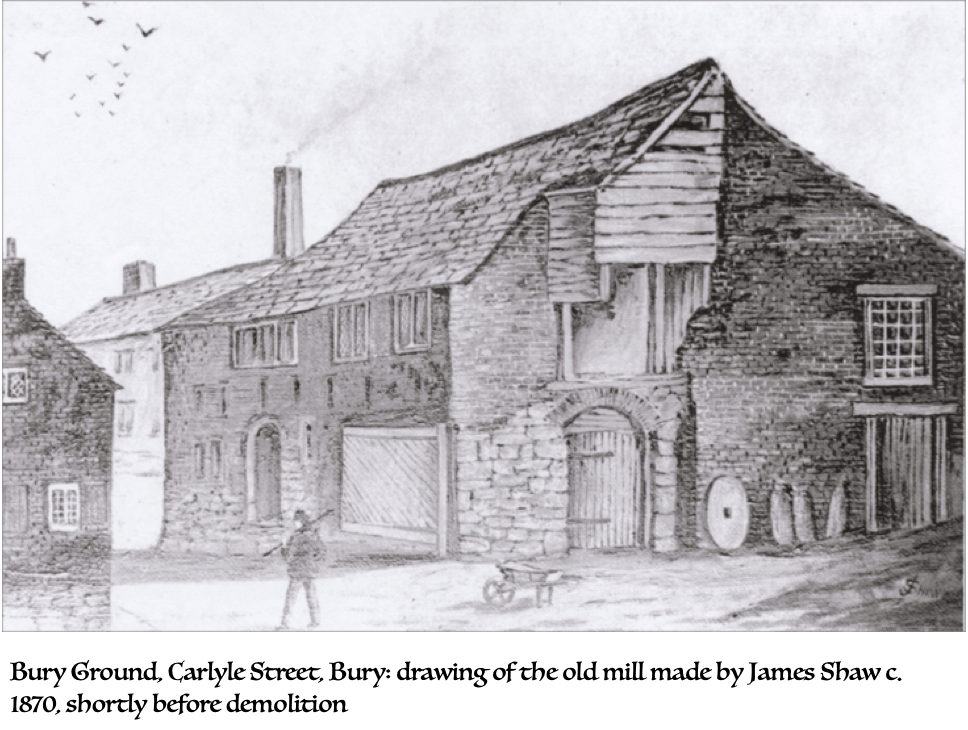
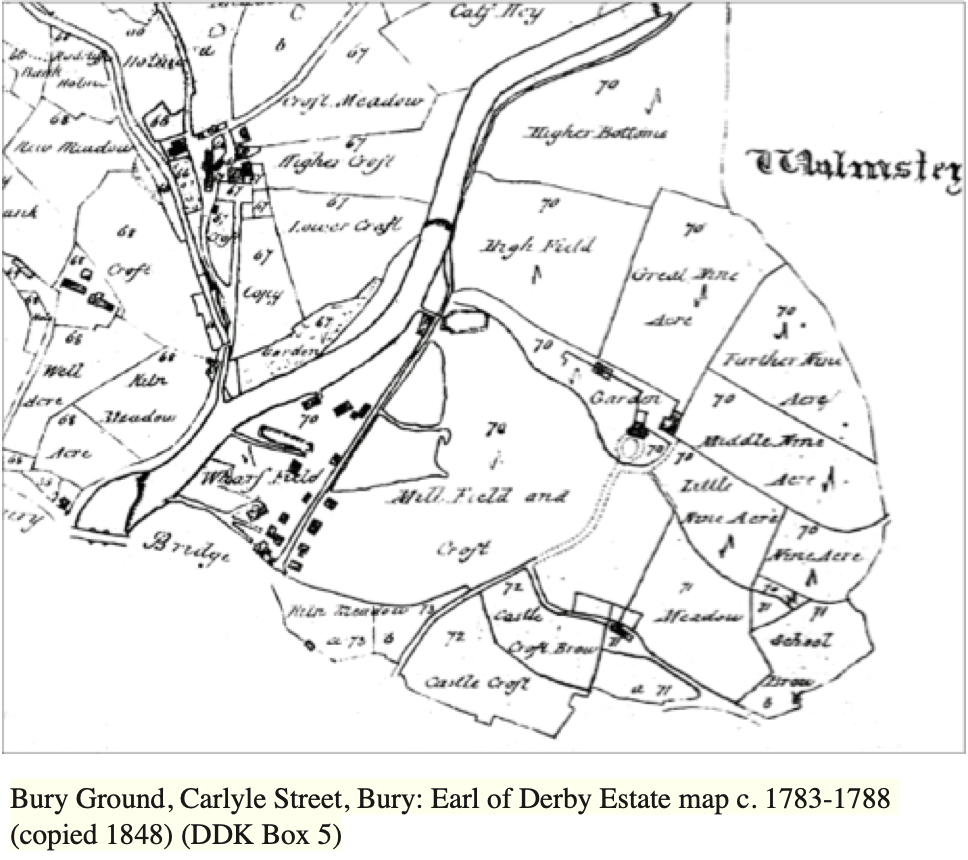
At this time, extensive lands around Bury and Tottington had been granted by the king to the Montbegone family. Roger de Montbegone gave some of his land to the knight Adam de Bury, who in turn shared it with freemen, including Roger de Noteho. Adam de Bury’s corn mill was probably sited at Bury Ground. Bury Ground almost certainly formed part of the demesne lands of the Castle, although later industrial activity has destroyed any evidence of former field boundaries and early land use. However, there is documentary evidence for the siting of a corn mill at the southern end of the site. Most medieval manors included a water powered corn mill which would have been an important source of revenue under the custom of ‘mill soke’. This meant that tenants were required to grind their corn at the lord’s mill for a fixed proportion of their grain.
While no charter granting land to Roger de Noteho has been found, There are charters between Adam de Bury (Biry or Byry) and others for the grant of land. The earliest, between Adam and the monks at St Mary Magdalen at Bretton, is a charter dated to AD 1210, just over 150 years after the Norman Conquest, and found in the ‘Lansdowne Manuscripts’ at the British Museum. The original was written in Latin, and roughly translates as:
‘To all the children of Holy Mother Church, be it known and made manifest that I, Adam de Biry, have given, conceded, and by this present charter have confirmed to God and St. Mary Magdalene of Bretton and to the monks serving there – and to the work of her church, one piece of land in Hep which is called Lummehalenges, divided as follows:- That is to say, from the rivulet which falls into Blackwell, through the centre of the moss as far as Meresache – as the land divides itself as far as Guledene, and from Guledene to the water of the Rached, together with all rights pertaining thereto in wood, in plain, in meadows, in pastures, and in waters, and with all common rights of communication, with their livestock with the same ville, wheresoever the livestock of my men communicate with the same ville of Hep. This gift and confirmation I have made to the aforesaid monks, and to whoever they may assign them, for the health of my soul – and that of my wife, and for the souls of my father and mother and of my ancestors and my heirs, in free and perpetual gift, holding of me and my heirs, freely, quietly, and freed from all lay interference, as a free gift. These being witnesses, Roger de Montbegon. William, the Son of Adam. Gilbert de Notton.’
The spelling of the place names mentioned here have changed over time, but most of them have survived. Hep is Heap, Lummehalenges has become Lomax. Guledene is now Gooden (near Hopwood), and the Rached is the River Roch. The location of ‘Blackwell’ and ‘Meresache’ remains a mystery for now.
The reason for this land grant was that Adam de Bury was a knight who held a lot of land in the local district under Roger de Montbegon, whose maternal grandfather Adam Fitswain had founded the Monk Bretton Priory near Barnsley, Yorkshire, in AD 1150. Roger was naturally a great supporter of the Priory founded and also made extensive grants of land in the Holcombe and Tottington districts to the Priory. Monk Bretton Priory closed in 1538 when Henry VIII appropriated the income and disposed of the assets of Catholic institutions around England.
Roger de Noteho has a son, Richard.
 Nuttall Family History