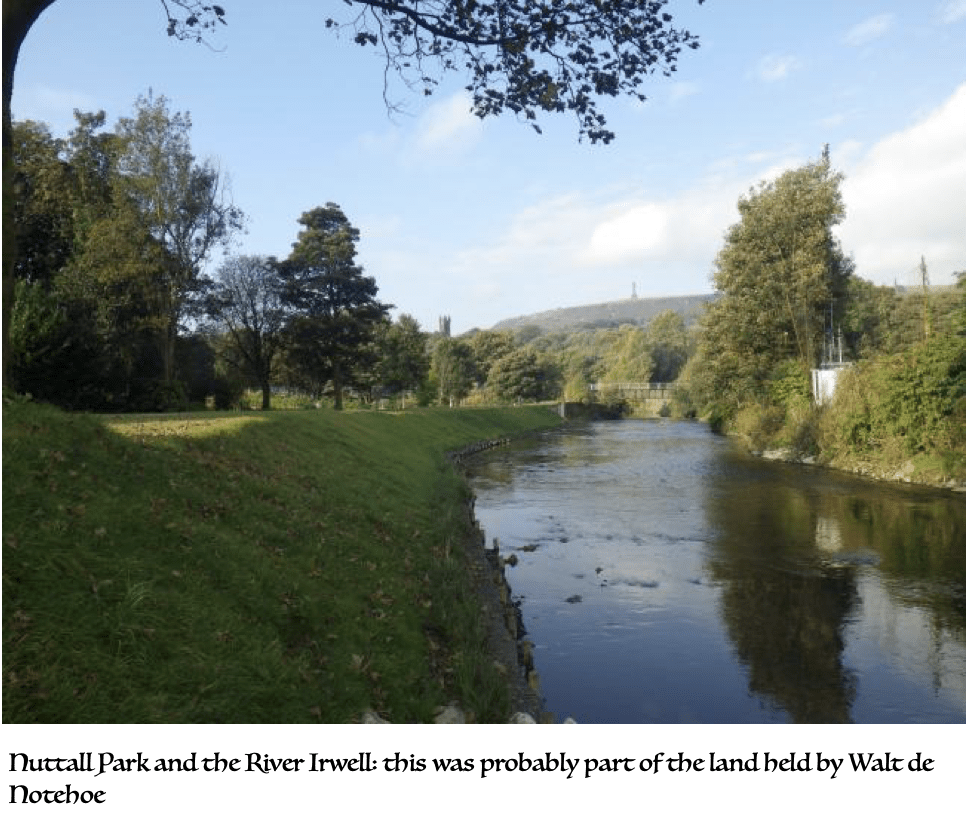
Walt. De Noteho appears in the Fine Rolls of King John for 1208 (see below). This is the he earliest record of a Nuttall. As we have seen above, Noteho is derived from “Hnut” and “How”, and is pre-conquest. Walt de Noteho seems therefore to be descended from the pre-conquest and even pre-Anglo-Saxon family who already lived near a tree-covered hill on the banks of the river Irwell.
All the surviving Oblata or Fine Rolls of the reign of King John were edited by Thomas Duffus Hardy and printed by the Commissioners of the Public Records in 1836. An entry for the ninth year of King John’s reign (1208) records a payment of 501 marks (a mark was worth 2/3 of a pound, or 13s 4d) to the King from Walt. de Noteho (an early form of Nuttall, bearing in mind that this was a time before printing had been invented and therefore spelling was not standardised and often varied wildly). This payment would have been in respect of land Walt held from the king, and presumably this was land was on the banks of the River Irwell near Bury at the place now called Nuttall and may have extended to Tottington or even further.
Walt would have farmed his land, probably with cows and maybe sheep, perhaps also growing wheat and corn.
King John reigned from 1199, following the death of his brother Richard II. The ninth year of King John’s reign was therefore 1208. If Walter was about 25, when he made the payment to King John, which seems likely, he must have been born in about 1183.
The appearance of Walter in the Fine Rolls of King John indicates that he held land in the Forest of Rossendale, probably at Tottington, near Bury, and the payment of 501 marks to King John was a land tax imposed by the King to raise revenues for his exchequer.
At that time, the Forest of Rossendale was part of the Honour of Lancaster, which after the Norman Conquest in 1066 was given by William the Conqueror to Roger de Poictou, third son of Roger de Montgomery, Earl of Arundel and Shrewsbury. Roger can safely hold the title as the First Lord of Lancashire.
On the succession of Henry II, the first of the Plantaganets, in 1154, they were given to Stephen’s son, William Earl of Warrenne and Count of Bologne.
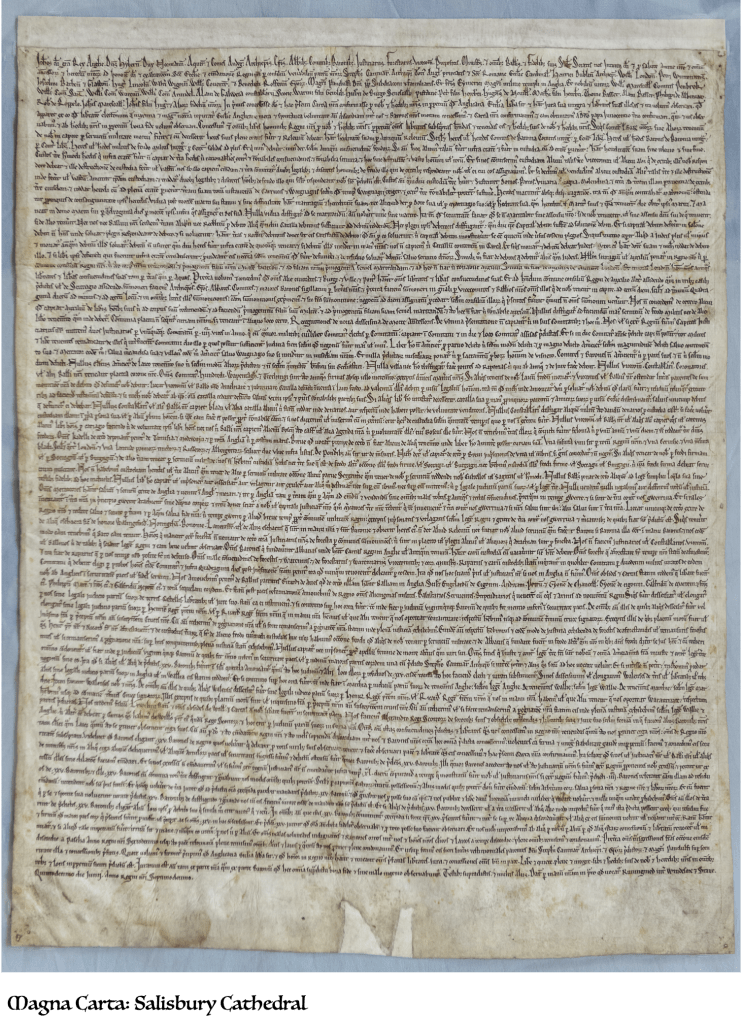
John became King in 1199, and was perhaps most famous for signing the Magna Carta. meaning ‘The Great Charter’. Originally issued as a practical solution to the political crisis he faced in 1215, Magna Carta established for the first time the principle that everybody, including the king, was subject to the law. Although nearly a third of the text was deleted or substantially rewritten within ten years, and almost all the clauses have been repealed in modern times, Magna Carta remains a cornerstone of the British constitution.
Most of the 63 clauses granted by King John dealt with specific grievances relating to his rule. However, buried within them were a number of fundamental values that both challenged the autocracy of the king and proved highly adaptable in future centuries. Most famously, the 39th clause gave all ‘free men’ the right to justice and a fair trial.
One of the barons who opposed the King was John de Lacy, constable of Chester, and a member of one of the oldest, wealthiest and most important baronial families of twelfth- and thirteenth-century England, with territorial interests distributed widely across the counties of the north Midlands and north. He would have been known to Walt de Noteho.
Walt de Noteho had a son, Roger, born around 1210.
 Nuttall Family History